Module 5 Political Parties
Unit 5 Political Parties in Texas
Introduction: Political Parties in Texas
Chapter Learning Objective
By the end of this chapter, you will be able to:
- Evaluate the role played by political parties in Texas
Introduction
At some point, most of us have found ourselves part of a group trying to solve a problem, like picking a restaurant or movie to attend or completing a big project at school or work. Members of the group probably had various opinions about what should be done. Some may have even refused to help make the decision or to follow it once it had been made. Still, others may have been willing to follow along but were less interested in contributing to a workable solution.
Because of this disagreement, at some point, someone in the group had to find a way to make a decision, negotiate a compromise, and ultimately do the work needed for the group to accomplish its goals.
This kind of collective action problem is very common in societies, as groups and entire societies try to solve problems or distribute scarce resources. In modern U.S. politics, such problems are usually solved by two important types of organizations: interest groups and political parties. There are many interest groups, all with opinions about what should be done and a desire to influence policy. Because they are usually not officially affiliated with any political party, they generally have no trouble working with either of the major parties. But at some point, society must find a way of taking all these opinions and turning them into solutions to real problems.
This is where political parties come in. Essentially, political parties are groups of people with similar interests who work together to create and implement policies. They do this by gaining control over the government by winning elections. Party platforms guide members of the Legislature in drafting legislation. Parties guide proposed laws through the Legislature and inform party members how they should vote on important issues. Political parties also nominate candidates to run for state government, Congress, and the presidency. Finally, they coordinate political campaigns and mobilize voters.
This chapter explores the role played by political parties in Texas.
Political Parties: Background and Structure
Political Parties: Background and Structure
Learning Objective
By the end of this section, you will be able to:
- Describe the evolution of political parties in Texas and the state’s current party system
Introduction: Political Parties as Unique Organizations in Texas
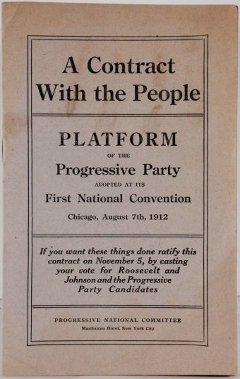
Figure 9.1 The party platform adopted at the first national convention of the Progressive Party in 1912. Among other items, this platform called for disclosure requirements for campaign contributions, an eight-hour workday, a federal income tax, and women’s suffrage. Image Credit: Public Domain
You can read the full platform of the Republican Party and the Democratic Party at their respective websites.
Political Parties: A History Lesson
In Federalist No. 10, written in the late eighteenth century, James Madison noted that the formation of self-interested groups, which he called factions, was inevitable in any society, as individuals started to work together to protect themselves from the government. Interest groups and political parties are two of the most easily identified forms of factions in the United States. These groups are similar in that they are both mediating institutions responsible for communicating public preferences to the government. They are not themselves government institutions in a formal sense. Neither is directly mentioned in the U.S. Constitution nor do they have any real, legal authority to influence policy. But whereas interest groups often work indirectly to influence our leaders, political parties are organizations that try to directly influence public policy through its members who seek to win and hold public office.
Parties accomplish this by identifying and aligning sets of issues that are important to voters in the hopes of gaining support during elections; their positions on these critical issues are often presented in documents known as a party platform, which is adopted at each party’s presidential nominating convention every four years. If successful, a party can create a large enough electoral coalition to gain control of the government. Once in power, the party is then able to deliver, to its voters and elites, the policy preferences they choose by electing its partisans to the government. In this respect, parties provide choices to the electorate, something they are doing that is in such sharp contrast to their opposition.
Winning elections and implementing policy would be hard enough in simple political systems, but in a country as complex as the United States, political parties must take on great responsibilities to win elections and coordinate behavior across the many local, state, and national governing bodies. Indeed, political differences between states and local areas can contribute much complexity. If a party stakes out issue positions on which few people agree and therefore builds too narrow a coalition of voter support, that party may find itself marginalized. But if the party takes too broad a position on issues, it might find itself in a situation where the members of the party disagree with one another, making it difficult to pass legislation, even if the party can secure victory.
It should come as no surprise that the story of U.S. political parties largely mirrors the story of the United States itself. The United States has seen sweeping changes to its size, its relative power, and its social and demographic composition. These changes have been mirrored by the political parties as they have sought to shift their coalitions to establish and maintain power across the nation and as party leadership has changed. As you will learn later, this also means that the structure and behavior of modern parties largely parallel the social, demographic, and geographic divisions within the United States today. To understand how this has happened, we look at the origins of the U.S. party system.
The Party-in-the-Electorate
A key fact about the U.S. political party system is that it’s all about the votes. If voters do not show up to vote for a party’s candidates on Election Day, the party has no chance of gaining office and implementing its preferred policies. As we have seen, for much of their history, the two parties have been adapting to changes in the size, composition, and preferences of the U.S. electorate. It only makes sense, then, that parties have found it in their interest to build a permanent and stable presence among the voters. By fostering a sense of loyalty, a party can insulate itself from changes in the system and improve its odds of winning elections. The party-in-the- electorate are those members of the voting public who consider themselves to be part of a political party and/or who consistently prefer the candidates of one party over the other.
What it means to be part of a party depends on where a voter lives and how much he or she chooses to participate in politics. At its most basic level, being a member of the party-in-the-electorate simply means a voter is more likely to voice support for a party. These voters are often called party identifiers, since they usually represent themselves in public as being members of a party, and they may attend some party events or functions.
Party identifiers are also more likely to provide financial support for the candidates of their party during election season. This does not mean self- identified Democrats will support all the party’s positions or candidates, but it does mean that, on the whole, they feel their wants or needs are more likely to be met if the Democratic Party is successful.
Party identifiers make up the majority of the voting public. Gallup, the polling agency, has been collecting data on voter preferences for the past several decades. Its research suggests that historically, over half of American adults have called themselves “Republican” or “Democrat” when asked how they identify themselves politically. Even among self- proclaimed independents, the overwhelming majority claim to lean in the direction of one party or the other, suggesting they behave as if they identified with a party during elections even if they preferred not to publicly pick a side. Partisan support is so strong that, in a poll conducted from August 5 to August 9, 2015, about 88 percent of respondents said they either identified with or, if they were independents, at least leaned toward one of the major political parties.
Thus, in a poll conducted in January 2016, even though about 42 percent of respondents said they were independent, this does not mean that they are not, in fact, more likely to favor one party over the other.
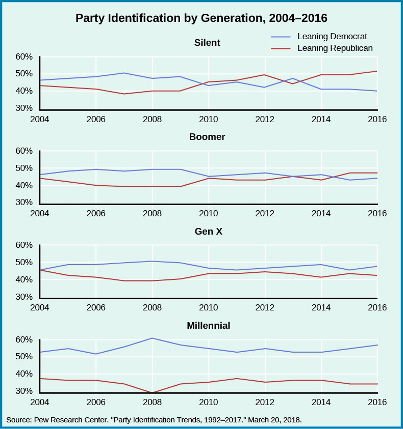
Figure 9.2 As the chart reveals, generation affects party identification. Millennials (aged 21–37) are more likely to identify as or lean towards the Democratic Party and less likely to favor Republicans than are their Baby Boomer parents and grandparents (born between 1946 and 1964).
Strictly speaking, party identification is not quite the same thing as party membership. People may call themselves Republicans or Democrats without being registered as a member of the party, and the Republican and Democratic parties do not require individuals to join their formal organization in the same way that parties in some other countries do.
Many states require voters to declare a party affiliation before participating in primaries, but primary participation is irregular and infrequent, and a voter may change his or her identity long before changing party registration. For most voters, party identification is informal at best and often matters only in the weeks before an election. It does matter, however, because party identification guides some voters, who may know little about a particular issue or candidate, in casting their ballots. If, for example, someone thinks of him- or herself as a Republican and always votes Republican, he or she will not be confused when faced with a candidate, perhaps in a local or county election, whose name is unfamiliar. If the candidate is a Republican, the voter will likely cast a ballot for him or her.
Party ties can manifest in other ways as well. The actual act of registering to vote and selecting a party reinforces party loyalty. Moreover, while pundits and scholars often deride voters who blindly vote their party, the selection of a party in the first place can be based on issue positions and ideology. In that regard, voting your party on Election Day is not a blind act—it is a shortcut based on issue positions.
The Party Organization
A significant subset of American voters views their party identification as something far beyond simply a shortcut to voting. These individuals get more energized by the political process and have chosen to become more active in the life of political parties. They are part of what is known as the party organization. The party organization is the formal structure of the political party, and its active members are responsible for coordinating party behavior and supporting party candidates. It is a vital component of any successful party because it bears most of the responsibility for building and maintaining the party “brand.” It also plays a key role in helping select, and elect, candidates for public office.
Local Organizations
Since winning elections is the first goal of the political party, it makes sense that the formal party organization mirrors the local-state-federal structure of the U.S. political system.
While the lowest level of party organization is technically the precinct, many of the operational responsibilities for local elections fall upon the county-level organization.
The county-level organization is in many ways the workhorse of the party system, especially around election time. This level of organization frequently takes on many of the most basic responsibilities of a democratic system, including identifying and mobilizing potential voters and donors, identifying and training potential candidates for public office, and recruiting new members for the party. County organizations are also often responsible for finding rank and file members to serve as volunteers on Election Day, either as officials responsible for operating the polls or as monitors responsible for ensuring that elections are conducted honestly and fairly. They may also hold regular meetings to provide members the opportunity to meet potential candidates and coordinate strategy. Of course, all this is voluntary and relies on dedicated party members being willing to pitch in to run the party.
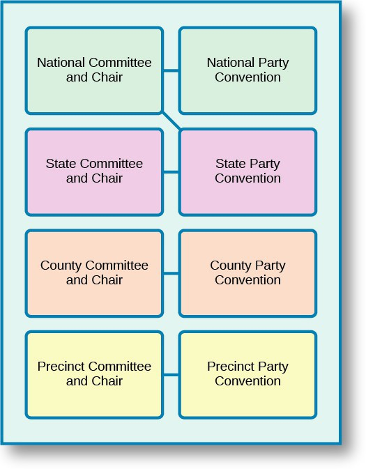
Figure 9.3 Political parties are bottom-up structures, with lower levels often responsible for selecting delegates to higher-level offices or conventions.
State Organizations
Most of the county organizations’ formal efforts are devoted to supporting party candidates running for county and city offices. But a fair amount of political power is held by individuals in statewide office or in state-level legislative or judicial bodies. While the county-level offices may be active in these local competitions, most of the coordination for them will take place in the state-level organizations. Like their more local counterparts, state-level organizations are responsible for key party functions, such as statewide candidate recruitment and campaign mobilization. Most of their efforts focus on electing high-ranking officials such as the governor or occupants of other statewide offices (e.g., the state’s treasurer or attorney general) as well as candidates to represent the state and its residents in the U.S. Senate and the U.S. House of Representatives. The greater value of state- and national-level offices requires state organizations to take on several key responsibilities in the life of the party.
First, state-level organizations usually accept greater fundraising responsibilities than do their local counterparts. Statewide races and races for national office have become increasingly expensive in recent years. The average cost of a successful House campaign was $1.2 million in 2014; for Senate races, it was $8.6 million. While individual candidates are responsible for funding and running their own races, it is typically up to the state-level organization to coordinate giving across multiple races and to develop the staffing expertise that these candidates will draw upon at election time.
State organizations are also responsible for creating a sense of unity among members of the state party. Building unity can be very important as the party transitions from sometimes-contentious nomination battles to the all-important general election. The state organization uses several key tools to get its members working together towards a common goal. First, it helps the party’s candidates prepare for state primary elections or caucuses that allow voters to choose a nominee to run for public office at either the state or national level. Caucuses are a form of town hall meeting at which voters in a precinct get together to voice their preferences, rather than voting individually throughout the day.

Figure 9.4 Caucus-goers gather at a Democratic precinct caucus on January 3, 2008, in Iowa City, Iowa. Caucuses are held every two years in more than 1650 Iowa precincts. Image Credit: Citizensharp Public Domain.
Second, the state organization is also responsible for drafting a state platform that serves as a policy guide for partisans who are eventually selected to public office. These platforms are usually the result of a negotiation between the various coalitions within the party and are designed to ensure that everyone in the party will receive some benefits if their candidates win the election.
Finally, state organizations hold a statewide convention at which delegates from the various county organizations come together to discuss the needs of their areas. The state conventions are also responsible for selecting delegates to the national convention.
National Party Organization
The local and state-level party organizations are the workhorses of the political process. They take on most of the responsibility for party activities and are easily the most active participants in the party formation and electoral processes. They are also largely invisible to most voters. The average citizen knows very little about the local party’s behavior unless there is a phone call or a knock on the door in the days or weeks before an election. The same is largely true of the activities of the state-level party. Typically, the only people who notice are those who are already actively engaged in politics or are being targeted for donations.
But most people are aware of the presence and activity of the national party organizations for several reasons. First, many Americans, especially young people, are more interested in the topics discussed at the national level than at the state or local level. According to John Green of the Ray C. Bliss Institute of Applied Politics:
“Local elections tend to be about things like sewers, and roads and police protection— which are not as dramatic an issue as same-sex marriage or global warming or international affairs.”
Presidential elections and the behavior of the U.S. Congress are also far more likely to make the news broadcasts than the activities of county commissioners, and the national-level party organization is mostly responsible for coordinating the activities of participants at this level. The national party is a fundraising army for presidential candidates and also serves a key role in trying to coordinate and direct the efforts of the House and Senate. For this reason, its leadership is far more likely to become visible to media consumers, whether they intend to vote or not.
A second reason for the prominence of the national organization is that it usually coordinates the grandest spectacles in the life of a political party. Most voters are never aware of the numerous county-level meetings or coordinating activities. Primary elections, one of the most important events to take place at the state level, have a much lower turnout than the nationwide general election. In 2012, for example, only one-third of the eligible voters in New Hampshire voted in the state’s primary, one of the earliest and thus most important in the nation; however, 70 percent of eligible voters in the state voted in the general election in November 2012.
People may see or read an occasional story about the meetings of the state committees or convention but pay little attention. But the national conventions, organized and sponsored by the national-level party, can dominate the national discussion for several weeks in late summer, a time when the major media outlets are often searching for news. These conventions are the definition of a media circus at which high-ranking politicians, party elites, and sometimes celebrities, such as actor/director Clint Eastwood, along with individuals many consider to be the future leaders of the party are brought before the public so the party can make its best case for being the one to direct the future of the country. National party conventions culminate in the formal nomination of the party nominees for the offices of president and vice president, and they mark the official beginning of the presidential competition between the two parties.
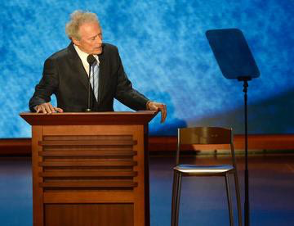
Figure 9.5 In August 2012, Clint Eastwood—actor, director, and former mayor of Carmel- by-the-Sea, California—spoke at the Republican National Convention accompanied by an empty chair representing the Democratic incumbent President Barack Obama. Image Credit: Theo’s Little Bot Fair Use
In the past, national conventions were often the sites of high drama and political intrigue. As late as 1968, the identities of the presidential and/or vice-presidential nominees were still unknown to the general public when the convention opened. It was also common for groups protesting key events and issues of the day to try to raise their profile by using the conventions to gain the media spotlight. National media outlets would provide “gavel to gavel” coverage of the conventions, and the relatively limited number of national broadcast channels meant most viewers were essentially forced to choose between following the conventions or checking out of the media altogether. Much has changed since the 1960s, however, and between 1960 and 2004, viewership of both the Democratic National Convention and the Republican National Convention had declined by half.
National conventions are not the spectacles they once were, and this fact is almost certainly having an impact on the profile of the national party organization. Both parties have come to recognize the value of the convention as a medium through which they can communicate to the average viewer. To ensure that they are viewed in the best possible light, the parties have worked hard to turn the public face of the convention into a highly sanitized, highly orchestrated media event. Speakers are often required to have their speeches prescreened to ensure that they do not deviate from the party line or run the risk of embarrassing the eventual nominee—whose name has often been known by all for several months.
And while protests still happen, party organizations have becoming increasingly adept at keeping protesters away from the convention sites, arguing that safety and security are more important than First Amendment rights to speech and peaceable assembly. For example, protestors were kept behind concrete barriers and fences at the Democratic National Convention in 2004.
With the advent of cable TV news and the growth of internet blogging, the major news outlets have found it unnecessary to provide the same level of coverage they once did. Between 1976 and 1996, ABC and CBS cut their coverage of the nominating conventions from more than fifty hours to only five. NBC cut its coverage to fewer than five hours.10 One reason may be that the outcome of nominating conventions are also typically known in advance, meaning there is no drama. Today, the nominee’s acceptance speech is expected to be no longer than an hour, so it will not take up more than one block of prime-time TV programming.
This is not to say the national conventions are no longer important, or that the national party organizations are becoming less relevant. The conventions, and the organizations that run them, still contribute heavily to a wide range of key decisions in the life of both parties. The national party platform is formally adopted at the convention, as are the key elements of the strategy for contesting the national campaign. And even though the media is paying less attention, key insiders and major donors often use the convention as a way of gauging the strength of the party and its ability to effectively organize and coordinate its members. They are also paying close attention to the rising stars who are given time at the convention’s podium, to see which are able to connect with the party faithful. Most observers credit Barack Obama’s speech at the 2004 Democratic National Convention with bringing him to national prominence.
The Party-in-Government
One of the first challenges facing the party-in-government, or the party identifiers who have been elected or appointed to hold public office, is to achieve their policy goals. The means to do this is chosen in meetings of the two major parties; Republican meetings are called party conferences and Democrat meetings are called party caucuses. Members of each party meet in these closed sessions and discuss what items to place on the legislative agenda and make decisions about which party members should serve on the committees that draft proposed laws. Party members also elect the leaders of their respective parties in the House and the Senate, and their party whips. Leaders serve as party managers and are the highest-ranking members of the party in each chamber of Congress. The party whip ensures that members are present when a piece of legislation is to be voted on and directs them how to vote. The whip is the second-highest ranking member of the party in each chamber. Thus, both the Republicans and the Democrats have a leader and a whip in the House, and a leader and a whip in the Senate. The leader and whip of the party that holds the majority of seats in each house are known as the majority leader and the majority whip. The leader and whip of the party with fewer seats are called the minority leader and the minority whip. The party that controls the majority of seats in the House of Representatives also elects someone to serve as Speaker of the House. People elected to Congress as independents (that is, not members of either the Republican or Democratic parties) must choose a party to conference or caucus with. For example, Vermont Senator Bernie Sanders, who ran for Senate as an independent candidate, caucuses with the Democrats in the Senate.
One problem facing the party-in-government relates to the design of the country’s political system. The U.S. government is based on a complex principle of separation of powers, with power divided among the executive, legislative, and judiciary branches. The system is further complicated by federalism, which relegates some powers to the states, which also have separation of powers. This complexity creates a number of problems for maintaining party unity. The biggest is that each level and unit of government has different constituencies that the office holder must satisfy. The person elected to the White House is more beholden to the national party organization than are members of the House or Senate, because members of Congress must be reelected by voters in very different states, each with its own state-level and county-level parties.
Some of this complexity is eased for the party that holds the executive branch of government. Executive offices are typically more visible to the voters than the legislature, in no small part because a single person holds the office. Voters are more likely to show up at the polls and vote if they feel strongly about the candidate running for president or governor, but they are also more likely to hold that person accountable for the government’s failures.
Members of the legislature from the executive’s party are under a great deal of pressure to make the executive look good, because a popular president or governor may be able to help other party members win office. Even so, partisans in the legislature cannot be expected to simply obey the executive’s orders. First, legislators may serve a constituency that disagrees with the executive on key matters of policy. If the issue is important enough to voters, as in the case of gun control or abortion rights, an office holder may feel his or her job will be in jeopardy if he or she too closely follows the party line, even if that means disagreeing with the executive. A good example occurred when the Civil Rights Act of 1964, which desegregated public accommodations and prohibited discrimination in employment on the basis of race, was introduced in Congress. The bill was supported by Presidents John F. Kennedy and Lyndon Johnson, both of whom were Democrats.
Nevertheless, many Republicans, such as William McCulloch, a conservative representative from Ohio, voted in its favor while many southern Democrats opposed it.
A second challenge is that each house of the legislature has its own leadership and committee structure, and those leaders may not be in total harmony with the president. Key benefits like committee appointments, leadership positions, and money for important projects in their home district may hinge on legislators following the lead of the party. These pressures are particularly acute for the majority party, so named because it controls more than half the seats in one of the two chambers. The Speaker of the House and the Senate majority leader, the majority party’s congressional leaders, have significant tools at their disposal to punish party members who defect on a particular vote. Finally, a member of the minority party must occasionally work with the opposition on some issues in order to accomplish any of his or her constituency’s goals. This is especially the case in the Senate, which is a super-majority institution. Sixty votes (of the 100 possible) are required to get anything accomplished, because Senate rules allow individual members to block legislation via holds and filibusters. The only way to block the blocking is to invoke cloture, a procedure calling for a vote on an issue, which takes 60 votes.
References and Resources
Texas Secretary of State. Candidate Information. Accessed October 19, 2019.
“Party Affiliation,” Gallup Poll. (March 1, 2016).
Jeffrey L. Jones, “Democratic, Republican Identification Near Historical Lows,” Gallup Poll. (March 14, 2016).
Russ Choma, “Money Won on Tuesday, But Rules of the Game Changed,” 5 November 2014. (March 1, 2016).
Elizabeth Lehman, “Trend Shows Generation Focuses Mostly on Social, National Issues.” March 15, 2016).
“Voter Turnout,” ElectProject.Org (March 14, 2016).
Abdullah Halimah, “Eastwood, the Empty Chair, and the Speech Everyone’s Talking About,” 31 August 2012, (March 14, 2016).
“Influence of Democratic and Republican Conventions on Opinions of the Presidential Candidates.” (March 14, 2016).
Timothy Zick, “Speech and Spatial Tactics,” Texas Law Review February (2006): 581.
Thomas E. Patterson, “Is There a Future for On-the-Air Televised Conventions?” (March 14, 2016).
Todd Leopold, “The Day America Met Barack Obama.” (March 14, 2016).
Sidney R. Waldman. 2007. America and the Limits of the Politics of Selfishness. New York: Lexington Books, 27.
Alicia W. Stewart and Tricia Escobedo (2014, April 10). “What You Might Not Know About the 1964 Civil Rights Act.”
Political Parties in Texas
Learning Objective
By the end of this section, you will be able to:
- Describe the history and trends of Texas’ major political parties
Introduction
Political parties are organized at three different levels: national, state, and local.
National consists of the quadrennial national convention, the party’s national chairpersons, and the party’s national committee. Next is the state, which consists of state central committees and state conventions, and congressional district committees. Lastly, there is the local level of organizations, which include city and county committees, precinct and ward committees, party activists and volunteers, and party identifiers and voters. Recent trends between the three levels are that they tend to overlap, and more often then not, state and local parties have more influence than the national party around their region, and their decisions tend to override those of the national party.
Major Political Parties in Texas
As of September 9, 2019, the state of Texas officially recognized four political parties. These are listed in the table below.
In order to be recognized by the state, a political party must fulfill certain requirements, which are detailed here: Ballot access requirements for political parties in Texas.
| Party | Website | By-Laws/Platform |
|---|---|---|
| Democratic Party of Texas | http://www.txdemocrats.org | http:/www.txdemocrats.org/pdf/rules1 |
| Green Party of Texas | http://web.txgreens.org | http://web.txgreens.org/node/7 |
| Libertarian Party of Texas | http://www.lptexas.org | http://www.lptexas.org/state-platform |
| Republican Party of Texas | http://www.texasgop.org/ | http://www.texasgop.org/wp-content/uploads/2015/06/SREC-Bylaw 2014-2016-06.06.15.pdf |
Table 9.1 Official Political Parties in Texas
In some states, a candidate may choose to have a label other than that of an officially recognized party appear alongside his or her name on the ballot. Such labels are called political party designations. A political party designation would be used when a candidate qualifies as an independent but prefers to use a different label. Texas does not allow candidates to identify in this way. A total of 25 states allow candidates to use political party designations in non- presidential elections.
The Cultural Background of Political Parties in Texas
The 19th-century culture of Texas was heavily influenced by the plantation culture of the Old South, dependent on African-American slave labor, as well as the patron system once prevalent (and still somewhat present) in northern Mexico and South Texas. In these societies, the government’s primary role was seen as being the preservation of social order. Solving of individual problems in society was seen as a local problem with the expectation that the individual with wealth should resolve his or her own issues.
Historical Dominance of the Democratic Party
From 1848 until Richard M. Nixon’s victory in 1972, Texas voted for the Democrat candidate for president in every election except 1928, when it did not support Catholic Al Smith. A full century of Democratic Governors stretched between the departure of Republican Governor E.J. Davis (1874) and the election of Republican William P. Clements (1979). The state had a white majority and Democrats re-established their dominance after the Civil War. In the mid-20th century 1952 and 1956 elections, the state voters joined the landslide for Dwight D. Eisenhower. (Texas did not vote in 1864 and 1868 due to the Civil War and Reconstruction).
In the post-Civil War era, two of the most important Republican figures in Texas were African Americans George T. Ruby and Norris Wright Cuney. Ruby was a black community organizer, director in the federal Freedmen’s Bureau, and leader of the Galveston Union League. His protégé Cuney was a mulatto whose wealthy, white planter father freed him and his siblings before the Civil War and arranged for his education in Pennsylvania. Cuney returned and settled in Galveston, where he became active in the Union League and the Republican party; he rose to the leadership of the party. He became influential in Galveston and Texas politics, and is widely regarded as one of the most influential black leaders in the South during the 19th century.
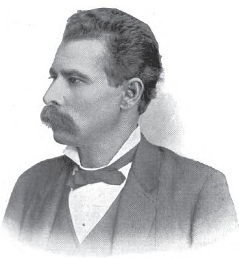
Figure 9.6 Norris Wright Cuney (May 12, 1846 – March 3, 1898) was an American politician, businessman, union leader, and African-American activist in Texas. Following the American Civil War, he became active in Galveston politics, serving as an alderman and a national Republican delegate. He was appointed as U.S. Collector of Customs in 1889 in Galveston. Cuney had the highest-ranking appointed position of any African American in the late 19th-century South.4 Image credit: Public Domain.
From 1902 through 1965, the Democrat-dominated legislature in Texas had virtually disenfranchised most blacks and many Latinos and poor whites through the imposition of the poll tax and white primaries. Voter turnout in Texas declined dramatically following these disenfranchisement measures, and Southern voting turnout was far below the national average. The Solid South exercised tremendous power in Congress, and Democrats gained important committee chairmanships by seniority. They gained federal funding for infrastructure projects in their states and the region, as well as support for numerous military bases, as two examples of how they brought federal investment to the state and region.
Although blacks made up 20 percent of the state population at the turn of the century, they were essentially excluded from formal politics. Republican support in Texas had been based almost exclusively in the free black communities, particularly in Galveston, and in the so-called “German counties” – the rural Texas Hill Country inhabited by German immigrants and their descendants, who had opposed slavery in the antebellum period. The German counties continued to run Republican candidates. Harry M. Wurzbach was elected from the 14th district from 1920 to 1926, contesting and finally winning the election of 1928, and being re-elected in 1930.
Some of the most important American political figures of the 20th century, such as President Lyndon B. Johnson, Vice-President John Nance Garner, Speaker of the House Sam Rayburn, and Senator Ralph Yarborough were Texas Democrats. But, the Texas Democrats were rarely united, being divided into conservative, moderate and liberal factions that vied with one another for power.
Republicans Rising
Some analysts suggest that the rebirth of the Republican Party in Texas among white conservatives can be traced to 1952, when Democrat Governor Allan Shivers clashed with the Truman Administration over the federal claim on the Tidelands, offshore lands claimed by both Texas and the national government which were believed to contain oil.
Shivers led a movement often known as the Shivercrat movement, which forecast a dramatic change in party alignments a quarter-century later. He worked to help Texas native General Dwight D. Eisenhower to carry the state. Eisenhower was generally highly respected due to his role as Commander of the Allies in World War II and was popular nationally, winning the election. Beginning in the late 1960s, Republican strength increased in Texas, particularly among residents of the expanding “country club suburbs” around Dallas and Houston. The election to Congress of Republicans such as John Tower (who had shifted from the Democrat Party) and George H. W. Bush in 1961 and 1966, respectively, reflected this trend.
Nationally, outside of the South, Democrats supported the civil rights movement and achieved important passage of federal legislation in the mid-1960s. In the South, however, Democrat leaders had opposed changes to bring about black voting or desegregated schools and public facilities and in many places exercised resistance. Following passage of the Civil Rights Act of 1964, southern white Democrats began to leave the party and join the Republicans, a movement accelerated after the next year, when Congress passed the Voting Rights Act of 1965, providing for federal enforcement of minorities’ constitutional right to vote. Voter registration and turnout increased among blacks and Latinos in Texas and other states.
Unlike the rest of the South, however, Texas voters were never especially supportive of the various third-party candidacies of Southern Democrats. It was the only state in the former Confederacy to back Democrat Hubert Humphrey in the 1968 presidential election. During the 1980s, a number of conservative Democrats defected to the GOP, including Senator Phil Gramm, Congressman Kent Hance, and GOP Governor Rick Perry, who was a Democrat during his time as a state lawmaker.
John Tower’s 1961 election to the U.S. Senate made him the first statewide GOP officeholder since Reconstruction and the disenfranchisement of black Republicans. Republican Governor Bill Clements and Senator Phil Gramm (also a former Democrat) were elected after him. Republicans became increasingly dominant in national elections in white-majority Texas. The last Democrat presidential candidate to win the state was Jimmy Carter in 1976. Previously, a Democrat had to win Texas to win the White House, but in the 1992 election, Bill Clinton won the Oval Office while losing Texas electoral votes. This result significantly reduced the power of Texas Democrats at the national level, as party leaders believed the state had become unwinnable.
Republican Dominance
As of June 2017, Democrats were the minority party in the state legislature, did not hold any statewide elected offices, and occupied 11 of the state’s 36 congressional seats.
After the 2018 election cycle, Republicans retained trifecta control of Texas state government; The Republican Party gained the state government trifecta in 2003. Republicans control all statewide Texas offices, both houses of the state legislature and have a majority in the Texas congressional delegation. This makes Texas one of the most Republican states in the U.S.
When one party controls the three vital centers of state political power—the office of the governor, the state House, and the state Senate — that party controls a trifecta. Trifectas make it easier for the dominant party to pursue its agenda, and more difficult for opposition parties to challenge it.
There are currently 36 trifectas: 22 Republican trifectas and 14 Democratic trifectas. Texas is one of the 22 state governments under Republican control.
Despite overall Republican dominance, Austin, the state capital, is primarily Democrat, as are El Paso, Houston, Dallas, San Antonio and the Rio Grande Valley. However, the suburbs of these cities remain heavily Republican.
What Does the Future Hold?
The Hispanic population has continued to increase, based on both natural increase and continued immigration from Mexico. As of 2011, the Hispanic population accounted for 38.1% of the state’s population (compared to 44.8% for non-Hispanic whites).
The state’s changing demographics may result in a change in its overall political alignment, as most Hispanic and Latino voters support the Democrat Party.
Analysts with Gallup suggest that low turnout among Texas Hispanics is all that enables continued Republican dominance. In addition to the descendants of the state’s former slave population, the African American population in Texas is also
increasing due to the New Great Migration; the majority supporting the Democrat party.
In 2018, Democratic Congressman Beto O’Rourke lost his Senate bid to the incumbent Ted Cruz by about 200,000 votes; a significant gain for Democrats in the state. O’Rourke’s performance in the 2018 Senate race has challenged the notion of Republican dominance in Texas, with analysts predicting greater gains for the Democrats going into the 2020s.
References and Further Reading
Texas Secretary of State. Candidate Information. Accessed September 9, 2019.
Texas Secretary of State. 2014 Independent Candidates.
Texas Election Code. Title 9, Section 142.009.
Hales, Douglas (2003). A Southern Family in White & Black: The Cuneys of Texas. Texas A&M University Press. ISBN 1-58544-200-3.
Democratic Party of Texas. Ballotpedia. Accessed September 21, 2019.
2010 Federal Census of Texas. Quick Facts.
Dugan, Andrew (2014). Texan Hispanics Tilt Democratic, but State Likely to Stay Red. Gallup. Rosenburg, Eli (2018, November 7). In Texas, Beto O’Rourke loses the race for Senate but still makes a mark. Washington Post. Accessed September 21, 2019.
Party Identification
Learning Objective
By the end of this section, you will be able to:
- Understand party identification and the organization of the major political parties in Texas
Introduction
Figure 9.7 Republican elephant and Democratic donkey icons. DonkeyHotey CC BY 2.0
This section explores the psychological underpinnings, measurement, and expression of party identification in Texas.
Political Ideologies
A political ideology is a certain set of ethical ideals, principles, doctrines, myths or symbols of a social movement, institution, class or large group that explains how society should work and offers some political and cultural blueprint for a certain social order.
Predominant Ideologies
Political ideologies in the United States (and as a subset, Texas) refers to the various ideologies and ideological demographics in the United States. Citizens in the U.S. generally classify themselves as adherent to positions along the political spectrum as either liberal, progressive, moderate, or conservative. Modern liberalism aims at the preservation and extension of human, social and civil rights as well as the government guaranteed provision of positive rights. Conservatism commonly refers to a combination of economic liberalism and libertarianism, and to an extent, social conservatism. It aims at protecting the concepts of small government and individual liberty while promoting traditional values on some social issues.
Liberalism
Liberals advocate strong civil liberties and social progressivism according to which societal practices need to be changed whenever necessary for the greater good of society or the benefits of those who wish to engage in those social arrangements. They believe that government action is needed in order for people to be as free as possible. The government must thereby ensure the provision of positive rights, protect civil liberties and ensure equality. Liberals commonly reject both laissez-faire capitalism and socialism as a means to distribute economic resources. A mixed economy, that is a capitalist free market economy with limited government regulation and intervention is seen as the ideal.
Conservatism
The word “conservative” comes from “conserve,” hence describing those who generally wish to conserve the status quo, conserve morality, or conserve money. Views on individual policies vary among different sub-groups. Overall, a majority of conservatives support tax- cuts and other laissez-faire (reduced governmental interference) policies, oppose same-sex marriage, oppose abortion, oppose stricter gun control laws on the grounds of the Second Amendment and public safety, and favor increased military spending as opposed to other federal expenditures. Conservatives tend to favor (racial) color-blindness and oppose affirmative action/positive discrimination quotas. Conservatives tend to favor state governments over the federal, reserving the federal for matters of national security.
Moderates
Moderate is a general term for people who fall in the center category between Liberals and Conservatives.
Moderates incorporate different aspects from liberalism and conservatism into their personal perspective. Moderates are commonly defined by limiting the extent to which they adopt liberal and conservative ideas
Where do your beliefs come from? The Pew Research Center offers a typology quiz to help you find out. Ask a friend or family member to answer a few questions with you and compare results. What do you think about government regulation? The military? The economy? Now compare your results. Are you both liberal? Conservative? Moderate?
Party Identification
Party identification refers to the political party with which an individual identifies. Party identification is loyalty to a political party. Party identification is typically determined by the political party that an individual most commonly supports (by voting or other means).
Some researchers view party identification as “a form of social identity,” or a psychological attachment in the same way that a person identifies with a religious or ethnic group. This identity develops early in a person’s life mainly through family and social influences. This description would make party identification a stable perspective, which develops as a consequence of personal, family, social and environmental factors. Other researchers consider party identification to be more flexible and more of a conscious choice. They see it as a position and a choice based on the continued assessment of the political, economic and social environment. Party identification can increase or even shift by motivating events or conditions in the country.
A number of studies have found that a partisan lens affects how a person perceives the world. Partisan voters judge character flaws more harshly in rival candidates than their own, believe the economy is doing better if their own side is in power, and underplay scandals and failures of their own side.
The past thirty years have brought a dramatic change in the relationship between the two parties as fewer conservative Democrats and liberal Republicans have been elected to office. As political moderates, or individuals with ideologies in the middle of the ideological spectrum, leave the political parties at all levels, the parties have grown farther apart ideologically, a result called partisan polarization. Partisan polarization is the degree to which Democrats have become more liberal and Republicans have become more conservative. In politics, partisan polarization may make it increasingly more difficult for politicians to compromise on critical policy issues.
Measuring Party Identification
It is important to measure party identification in order to determine its strengths and weaknesses. Political scientists have developed many ways to measure party identification in order to examine and evaluate it.
One American method of measuring party identification uses the Likert Scale, a 7-point scale to measure party identification, with Strong Democrat on one extreme and Strong Republican at the other. In between the two extremes are the classifications of “Lean Democrat/Republican” and “Weak Democrat/Republican.”
The Importance of Party Identification
Political scientists often refer to party identification as a “vote determinant.” Those people who identify with a party tend to vote for their party’s candidate for various offices in high percentages. Those who consider themselves to be strong partisans, strong Democrats and strong Republicans respectively, tend to be the most faithful in voting for their party’s nominee for office. In the case of voting for president, since the 1970s, party identification on voting behavior has been increasing significantly. By the late 1990s, party identification on voting behavior was at the highest level of any election since the 1950s.
When voting in congressional elections, the trend is similar. Strong party identifiers voted overwhelmingly for their party’s nominee in the general election. It is important to note that each party respectively in certain elections, would have stronger voting behavior of their strongest party identifiers. For instance, in the years the Democrats dominated House and Senate elections in the 1970s and 1980s, it can be explained that their strong party identifiers were more loyal in voting for their party’s nominee for Congress than the Republicans were.
The same level of voting behavior can also be applied to state and local levels.
While straight-ticket voting has declined among the general voting population, it is still prevalent in those who are strong Republicans and strong Democrats. According to Paul Allen Beck and colleagues, “the stronger an individual’s party identification was, the more likely he or she was to vote a straight ticket.”
The Distribution of Party Identification in Texas
Using the methodology described above, the University of Texas and the Texas Tribune surveyed respondents about their party identification. Figure 9.8 illustrates the results.
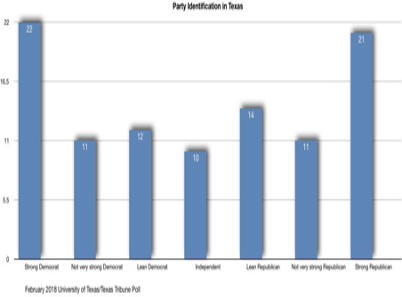
Figure 9.8 Party Identification in Texas. UT/Texas Tribune February 2018 Poll. Image credit: Texas Politics Project, the University of Texas at Austin
Democratic and Republican Party Organization
Although many Texans claim that they are “registered Republicans” or “registered Democrats,” Texas does not have a system of party registration. Registered voters may vote in either the Democrat or Republican primary.
One of the most important functions of political parties is to select candidates to run for office under the party label, which is currently accomplished through primary elections.
Permanent Party Organization
Organization of the parties themselves are often discussed in terms of the permanent organization of the party and the temporary (campaign) organization of the party (See Figure 9.9). In each election precinct, a precinct chair will be elected in the party primary. The precinct chair will head the precinct convention, in addition to serving on the party’s county executive committee. In the primary, the county chair will also be elected. The county chair will lead the county executive committee, which is composed of the chair and precinct chairs. The main responsibility of the county executive committee is to run the county primary and plan the county conventions.
At the state level, there is a state executive committee, which includes a state chair and vice-chair. These officers are selected every two years at the state party conventions. The state executive committee:
- accepts filings by candidates for statewide office
- helps raise funds for the party
- and establishes party policy
Temporary Party Organization
The temporary organization of the party includes the precinct conventions. The main role of the precinct conventions is to select delegates to the county convention and to possibly submit resolutions that may eventually become part of the party platform.
Delegates chosen at the precinct convention then go to the county conventions (or in urban areas, to district conventions). These conventions elect delegates to the state convention. Democratic and Republican parties hold state conventions every other year.
At the state convention:
- nominees are certified for statewide office
- a party platform is adopted
- and a chair, vice-chair, and state executive committee is elected
In presidential election years, the state conventions:
- select delegates for the national party conventions
- elect delegates for the national party committee
- and choose presidential electors to the Electoral College
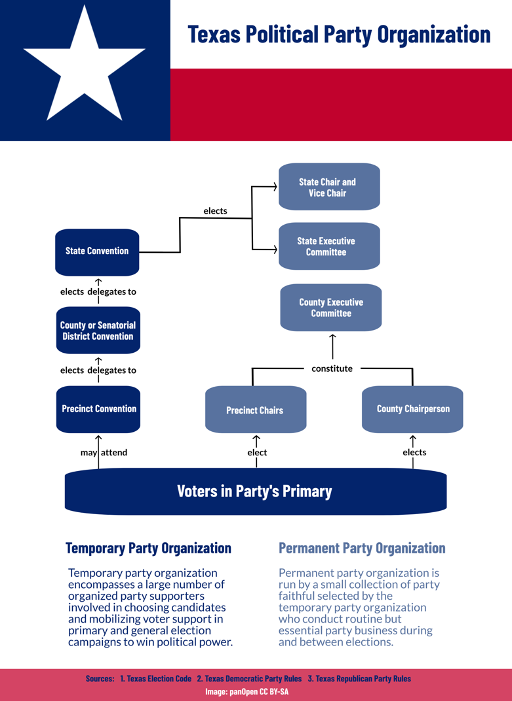
Figure 9.9 Temporary Party Organization encompasses a large number of organized party supporters involved in choosing candidates and mobilizing voter support in primary and general election campaigns to win political power. Permanent Party Organization is run by a small collection of party faithful selected by the temporary party organization who conduct routine but essential party business during and between elections. The elements of both aspects of party organization are depicted using an organizational flow chart. Image created based on sources: Texas election code; Democratic and Republican party rules; credit: panOpen License: CC BY-SA
Recommended Websites
References and Further Reading
The Texas Politics Project. University of Texas/Texas University of Texas/Texas Tribune’s February 2018 Poll.
Texas Election Code - Texas Statutes. TITLE 10. POLITICAL PARTIES. Accessed October 18, 2019.
Third-Party Movements in Texas
Learning Objective
By the end of this section, you should be able to:
- Discuss electoral trends in Texas, specifically dealigned parties and third- party movements
Introduction: Third-Party Movements in Texas
At various points in the past 170 years, elites and voters have sought to create alternatives to the existing party system. Political parties that are formed as alternatives to the Republican and Democratic parties are known as third parties, or minor parties. As with many other states, the two-party system in Texas has made it very difficult for third parties to get on the ballot.
Many voters believe that their votes would be wasted if they vote for a third-party candidate. Because the history of elections shows that a Republican or Democrat will almost always win, most voters decide that it is more rational to vote for the major-party candidate whose ideology most closely aligns with their own.
La Raza Unida
La Raza Unida, meaning “united race,” was created in the early 1970s to combat growing inequality and dissatisfaction with the Democratic Party that was typically supported by Mexican-American voters. José Ángel Gutiérrez led the party at its inception, which was concentrated in Zavala County. After its establishment in Texas, the party launched electoral campaigns in Colorado, Arizona, New Mexico, and California, though it only secured official party status for statewide races in Texas.
La Raza Unida was able to win races in Crystal City, Cotulla, and Carrizo Springs in Texas by taking advantage of nonpartisan elections. The party did so well in Zavala County and other surrounding counties that at one point the party won two city council majorities, two school board majorities, and two mayoralties.
Although the party did poorly in the 1978 Texas elections and leaders and members dropped away, it signified the growing influence of Latinos in the state.
Green Party of Texas
The Green Party of Texas is the state party organization for Texas of the Green Party of the United States. The party was founded as the electoral arm of the political movements for grassroots democracy, social justice, ecological wisdom, peace, and nonviolence.
The Green Party of Texas began to organize a statewide grassroots effort in the late 1990s. Small, active Green groups existed in large cities throughout the state (particularly Houston, Dallas, and Austin) before this time, but Ralph Nader’s 1996 campaign spurred the growth of the Green Party of Texas.
The Texas Green Party has retroactively gained ballot access through 2026 via the passage and signing of HB-2504 in 2019 after having obtained 2% of the statewide vote for Railroad Commissioner in 2016.
Libertarian Party of Texas
In recent years, the Libertarian Party of Texas has emerged as a third-party alternative to the two major political parties. Libertarians believe in limited government and are typically considered fiscal conservatives and social liberals. Although the Libertarian Party has been unsuccessful at the polls and has had little impact on Election Day, they can influence politics in other ways. For example, the major parties may adopt some of the positions promoted by Libertarians (or members of other minor parties) in order to win their support in run-off elections.
The Occupy and Tea Party Movements in Texas
The new voices of the Occupy and Tea Party movements have become prominent both nationwide as well as in Texas. Created following government bailouts in 2008, the Occupy movement has held demonstrations in Austin and other major Texas cities, protesting the influence of big corporations and Wall Street on American politics.
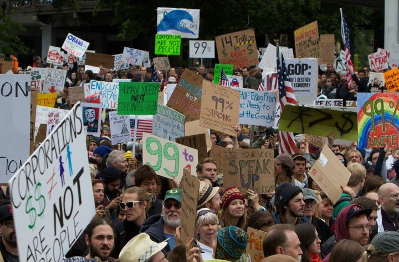
Figure 9.10 Occupy Wall Street protesters in Portland, Oregon. Occupy Wall Street protesters have been critical of lobbying in government. Image credit: S51438 CC-BY-SA-3.0
Born in part from an older third-party movement known as the Libertarian Party, the Tea Party movement has allied itself with the Republican Party and has had greater influence in Texas due to its antitax messaging.
The Tea Party movement was launched following a February 19, 2009 call by CNBC reporter Rick Santelli on the floor of the Chicago Mercantile Exchange for a “tea party,” when several conservative activists agreed by conference call to coalesce against Obama’s agenda and scheduled a series of protests.
Supporters of the movement subsequently have had a major impact on the internal politics of the Republican Party.
The Tea Party is more hostile to government and views government intervention in all forms, and especially taxation and the regulation of business, as a threat to capitalism and democracy. It is less willing to tolerate interventions in the market place, even when they are designed to protect the markets themselves. Although an anti-tax faction within the Republican Party has existed for some time, some factions of the Tea Party movement are also active at the intersection of religious liberty and social issues, especially in opposing such initiatives as same-sex marriage and abortion rights. The Tea Party has argued that government, both directly and by neglect, is threatening the ability of evangelicals to observe their moral obligations, including practices some perceive as endorsing social exclusion.
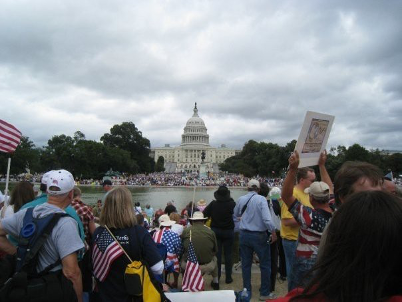
Figure 9.11 Tea Party protesters on the West Lawn of the U.S. Capitol and the National Mall at the Taxpayer March on Washington on September 12, 2009. Image credit: NYyankies51 License: CC-BY-SA-3.0
Although the Tea Party is a movement and not a political party, 86 percent of Tea Party members who voted in 2012 cast their votes for Republicans. Additionally, research has shown that members of the Tea Party Caucus vote like a third party in Congress. Some members of the Republican Party are closely affiliated with the movement, and before the 2012 elections, Tea Party activist Grover Norquist exacted promises from many Republicans in Congress that they would oppose any bill that sought to raise taxes.
The inflexibility of Tea Party members has led to tense floor debates and was ultimately responsible for the 2014 primary defeat of Republican majority leader Eric Cantor and the 2015 resignation of the sitting Speaker of the House John Boehner. In 2015, Chris Christie, John Kasich, Ben Carson, Marco Rubio, and Ted Cruz, all of whom were Republican presidential candidates, signed Norquist’s pledge as well.
References and Further Reading
Ballotpedia. Minor Political Party. Accessed October 18, 2019.
Acosta, T. P. (2019, May 7). “RAZA UNIDA PARTY.” Handbook of Texas Online. Retrieved October 16, 2019.
Juarez, A. (1972). The Emergence of El Partido De La Raza Unida: California’s New Political Party.
M. Garcia, I. M. (1989). United we win: The rise and fall of La Raza Unida Party. University of Arizona Press. José Ángel Gutiérrez Papers, Benson Latin American Collection, University of Texas at Austin. Raza Unida Party Collection, Benson Latin American Collection, University of Texas at Austin.
Byrne, E. (2019, May 20). Critics say bill moving through Texas Legislature designed to aid GOP reelection bids. The Texas Tribune. Retrieved October 20, 2019.
Etheridge, E. (2009, Feb 20). “Rick Santelli: Tea Party Time.” New York Times: Opinionator.
Pallasch, A. M. (2010, September 19). ‘Best 5 minutes of my life’; His ‘09 CNBC rant against mortgage bailouts for ’losers’ ignited the Tea Party movement. Chicago Sun-Times. p. A4.
Pew Research Center (2011, Feb 23). The Tea Party and Religion. Accessed October 16, 2019.
Ragusa, J. & Gaspar, A. (2016). Where’s the Tea Party? An Examination of the Tea Party’s Voting Behavior in the House of Representatives. Political Research Quarterly. 69 (2): 361-372. doi:10.1177/1065912916640901.
Waldman, P. (2015, Aug 13). Nearly All the GOP Candidates Bow Down to Grover Norquist, The Washington Post. Accessed October 16, 2019.
Candidate and Delegate Selection Processes in Texas
Learning Objectives
By the end of this section, you should be able to:
- Compare and contrast primary and caucus candidate and delegate selection processes
Introduction
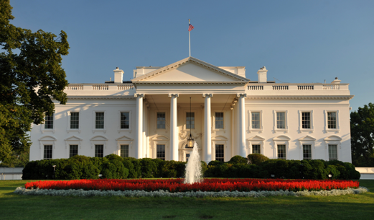
Figure 9.12 Presidential nominees are formally nominated at political party conventions. Primary elections are used to determine whom a state’s delegation should support at party nominating conventions. Image credit: Cezary p CC BY-SA 4.0
This section discusses the candidate and delegate selection process in Texas.
Primary Election Systems Used in Texas
Presidential Elections
Presidential candidates in the United States are not directly nominated via primary elections; instead, presidential nominees are formally nominated at political party conventions. Presidential preference primary elections and caucuses are held in each state to determine how that state’s delegation will vote during the nominating convention. The guidelines governing presidential nominating processes are set by the national committees of political parties, which in turn authorize individual state-level parties to conduct their own primaries and caucuses in accordance with their own participation standards. The terms under which presidential primaries are conducted therefore vary from state to state and from election cycle to election cycle.
In 2016, a total of 35 U.S. jurisdictions (including both states and territories) held presidential preference primaries to allocate convention delegates to both the Democratic and Republican parties’ presidential candidates. In 13 jurisdictions, both parties held caucuses instead to allocate delegates. Eight jurisdictions utilized a bifurcated process in which one party held a primary and the other conducted a caucus or convention.
In 2016, Texas’ political parties conducted open presidential preference primaries. Voters were not required to be a member of a party to participate in its primary.
Congressional and State-Level Elections
In 22 states, at least one political party utilizes open primaries to nominate partisan candidates for congressional and state-level (e.g. state legislators, governors, etc.) offices. In 15 states, at least one party utilizes closed primaries to nominate partisan candidates for these offices. In 14 states, at least one party utilizes semi-closed primaries. In two (California and Washington), top-two primaries are utilized.
Texas law requires parties to conduct open primary elections for state and county offices, as well as for congressional offices. During the nineteenth century, candidates were nominated at party conventions, but early in the 20th century, the state moved to the primary as a way to select candidates. Winners in primary contests are determined by majority vote. In the case that no candidate receives a majority vote, the top two candidates proceed to a runoff election.
| Office | Number of Seats |
|---|---|
| Governor of Texas | 1 |
| Lieutenant Governor of Texas | 1 |
| Attorney General of Texas | 1 |
| Land Comptroller of Public Accounts | 1 |
| Texas Land Commissioner | 1 |
| Texas Agriculture Commissioner | 1 |
| Texas Railroad Commission | 3 |
| State Legislators | 181 |
| United States Senators | 2 |
| United States Representatives | 36 |
| Local Officials | Varies by municipality |
Table 9.2 Elective offices for Which Parties Must Conduct Primaries to Nominate General Election Candidates .Table adapted from Ballotpedia, Primary Elections in Texas, published under a GFDL License
The Texas Caucuses
The Texas caucuses are a political event associated with primaries, the process by which voters in the Texas ultimately select their parties’ nominees for various offices. The process as a whole has been referred to as the Texas Two-Step, after the partner dance of the same name, because Texans were required to first vote in the primary election in order to be eligible for participation in party caucuses in which delegates were selected.
The current process differs for Democrats and Republicans.
The Republican Party of Texas has a winner-take-all provision in its primary, and the chances any candidate will get all of that party’s Texas delegates are very small. That candidate would have to win more than 50 percent of the vote statewide, and also in each of the state’s 36 congressional districts, to run the table. Absent such an event, a pro-rata system is followed to allocate delegates roughly according to votes received.
The Texas Democratic Party no longer selects state delegates at caucuses. After the votes of Texans participating in the Democratic primary are counted, delegates are awarded among the candidates who received 15 percent or more of the vote, in proportion to the votes received by each.
It would be even harder for a Democrat than for a Republican to get all of the Texas delegates from their party in a presidential primary. A democratic candidate could do so only by winning 85% of the vote statewide and, separately, 85% in each and every one of Texas’ 31 state Senate districts.
Controversies
The Texas Democratic Party abandoned the former caucus-based “Texas Two-step” primary system in 2015.
The Democratic County (Senate District) Conventions in late March 2008 produced a great deal of confusion. Both Clinton and Obama supporters had concerns about how these conventions were conducted. The most common complaint had to do with the fact that delegates were not being apportioned based on Precinct Convention results. For instance, in Kleberg County, 9 delegates were elected to attend the State Convention, with only one Obama supporter among them. Obama won about one-third of the votes in the Precinct Caucuses/Conventions in Kleberg County.
References and Further Reading
Bartels, L. (1988). Presidential Primaries and the Dynamics of Public Choice. Princeton, NJ: Princeton University Press. (page 22)
Democratic National Committee, “2016 Democratic National Convention Delegate/Alternate Allocation,”
updated February 19, 2016
CNN.com, “Democratic National Convention Roll Call,” July 26, 2016
Republican National Committee, “2016 Presidential Nominating Process” accessed October 11, 2015
CNN.com, “Republican National Convention roll call vote,” accessed July 20, 2016
FairVote, “Who Can Vote in Congressional Primaries,” accessed August 17, 2017
National Conference of State Legislatures, “State Primary Election Types,” July 21, 2016
Texas Legislature, “Chapter 172. Primary Elections,” accessed September 2, 2017
Nassar, George. “Texas Democratic Caucus FAQ.” The Texas Blue. 03/04/2008.
“Texas Democrats dropping confusing caucus system.” Christy Hoppe. June 2015.
Glossary
Glossary: Political Parties in Texas
Occupy movement: aimed at limiting the influence of Wall Street and big corporations in American politics.
partisan polarization: the degree to which Republicans have become more conservative and Democrats have become more liberal
party-in-government: party identifiers who have been elected or appointed to hold public office
party organization: the formal structure of a political party that facilitates the coordination of party behavior and support for party candidates.
party platform: a statement of principles and purpose issued by a political party
political ideology: a certain set of ethical ideals, principles, doctrines, myths or symbols of a social movement, institution, class or large group that explains how society should work and offers some political and cultural blueprint for a certain social order
political party: a political organization that subscribes to a certain ideology and seeks to attain political power through representation in government
political socialization: the process by which we are trained to understand and join a country’s political world
public opinion: a collection of popular views about something; for example, a person, a local or national event, or a new idea
Shivercrat movement: a movement led by the Texas governor Allan Shivers during the 1950s in which conservative Democrats in Texas supported Republican candidate Dwight Eisenhower for the presidency because many of those conservative Democrats believed that the national Democratic party had become too liberal
straight-ticket voting: the practice of voting for every candidate that a political party has on a general election ballot
The Tea Party movement: an American fiscally-conservative political movement within the Republican Party that has called for lower taxes, and for a reduction of the national debt of the United States and federal budget deficit through decreased government spending
third parties (minor parties): political parties that are formed as alternatives to the Republican and Democratic parties
** trifecta**: when one party controls the three vital centers of state political power—the office of the governor, the state House, and the state Senate
two-party system: a system where two major political parties dominate voting in nearly all elections at every level of government and, as a result, nearly all elected officials are members of one of the two major parties
white primary: primary election in which only white voters are eligible to participate
Political Parties Ungraded Practice Quiz
Check your knowledge of Chapter Nine by taking the ungraded practice quiz linked below.
Licensing and Attribution
CC LICENSED CONTENT, SHARED PREVIOUSLY
American Government. Authored by: OpenStax. Provided by: OpenStax; Rice University. Located at https://cnx.org/contents/W8wOWXNF@12.1:Y1CfqFju@5/Preface. License: CC BY: Attribution License Terms