Module 4 Voting
Voting and Political Participation in Texas
Introduction: Voting and Political Participation in a Changing Texas
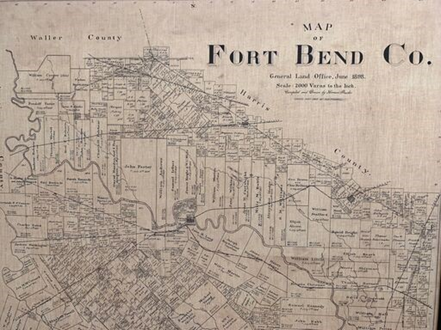
Figure 7.1 This 1898 General Land Office map of Fort Bend County shows land grants that date back to those secured from Spain by Stephen F. Austin. Many of the original bounderies are still in place today. Image Credit: Andrew Teas, License: CC BY
Fort Bend County covers an area along the Brazos River southwest of Houston. For most of the 20th Century, it was a rural area known for ranching and cotton farming, and as the home of Imperial Sugar and several large state prisons. As Texas shifted from a predominantly Democratic to a predominantly Republican state in the 1970s, Fort Bend County’s rural, conservative roots brought it enthusiastically along with the trend. In 1976, only 39 percent of Fort Bend voters selected Jimmy Carter for President in a race in which he carried Texas over President Gerald Ford.
In the 2000s, Republican majorities began to shrink. Mitt Romney won Fort Bend County with only 53 percent in 2012, and Hillary Clinton carried Fort Bend County in 2016, even as 52 percent of Texas voters chose Donald Trump.
In the 2018 election, every countywide election was won by a Democrat, with challenger Beto O’Rourke outpolling incumbent Republican Senator Ted Cruz by more than 11 points, even as Cruz was reelected statewide. How did rural/suburban Fort Bend County become what appears to be at least a Democratic-leaning, if not solidly Democratic, county?
The answer lies at least partly in demographics. The population of Fort Bend grew almost 30 percent from 2010 to the 2018 election, and the 19 percent growth in Anglos was far outpaced by Asians (56%), Hispanics (33%) and African Americans (22%). The latest Census data shows Fort Bend as the most diverse county in Texas – meaning that it has the most closely equal percentages of the four major racial groups at 35% Anglo, 24% Hispanic, 20% African American and 21% Asian and other.
For better or worse, race is a strong predictor of political party preferences. As non-Anglo races become a larger percentage of the population and – more importantly – a larger percentage of the electorate throughout Texas, many predict that Texas’ days as a reliably Republican state are numbered.
How and why do Texans participate in politics?
Introduction
Before most voters are allowed to cast a ballot, they must register to vote in their state. This process may be as simple as checking a box on a driver’s license application or as difficult as filling out a long form with complicated questions. Registration allows governments to determine which citizens are allowed to vote and, in some cases, from which list of candidates they may select a party nominee. Ironically, while the government wants to increase voter turnout, the registration process may prevent various groups of citizens and non-citizens from participating in the electoral process.
Voter Registration Across the United States
Elections in the United States are state-by-state contests. They include general elections for president and statewide offices (e.g., governor and U.S. senator), and they are often organized and paid for by the states. Because political cultures vary from state to state, the process of voter registration similarly varies. For example, suppose an 85-year-old retiree with an expired driver’s license wants to register to vote. He or she might be able to register quickly in California or Florida, but a current government ID might be required prior to registration in Texas or Indiana.
The varied registration and voting laws across the United States have long caused controversy. In the aftermath of the Civil War, southern states enacted literacy tests, grandfather clauses, and other requirements intended to disenfranchise black voters in Alabama, Georgia, and Mississippi. Literacy tests were long and detailed exams on local and national politics, history, and more. They were often administered arbitrarily with more blacks required to take them than whites.
Who is Allowed to Vote?
In order to be eligible to vote in the United States, a person must be a citizen, resident, and eighteen years old. But states often place additional requirements on the right to vote. The most common requirement is that voters must be mentally competent and not currently serving time in jail. Some states enforce more stringent or unusual requirements on citizens who have committed crimes. Florida and Kentucky permanently bar felons and ex-felons from voting unless they obtain a pardon from the governor, while Mississippi and Nevada allow former felons to apply to have their voting rights restored.
On the other end of the spectrum, Vermont does ot limit voting based on incarceration unless the crime was election fraud. Maine citizens serving in Maine prisons also may vote in elections. Beyond those jailed, some citizens have additional expectations placed on them when they register to vote. Wisconsin requires that voters “not wager on an election,” and Vermont citizens must recite the “Voter’s Oath” before they register, swearing to cast votes with a conscience and “without fear or favor of any person.”
How Does Someone Register to Vote?
The National Commission on Voting Rights completed a study in September 2015 that found state registration laws can either raise or reduce voter turnout rates, especially among citizens who are young or whose income falls below the poverty line. States with simple voter registration had more registered citizens.
Another aspect of registering to vote is the timeline. States may require registration to take place as much as thirty days before voting, or they may allow same-day registration. Maine first implemented same-day registration in 1973. Fourteen states and the District of Columbia now allow voters to register the day of the election if they have proof of residency, such as a driver’s license or utility bill. Many of the more populous states (e.g., Michigan and Texas), require registration forms to be mailed thirty days before an election. Moving means citizens must re-register or update addresses. College students, for example, may have to re-register or update addresses each year as they move. States that use same-day registration had a 4 percent higher voter turnout in the 2012 presidential election than states that did not.
In all states except North Dakota, a citizen wishing to vote must complete an application. Whether the form is online or on paper, the prospective voter will list his or her name, residency address, and in many cases party identification (with Independent as an option) and affirm that he or she is competent to vote. States may also have a residency requirement, which establishes how long a citizen must live in a state before becoming eligible to register: it is often 30 days. Beyond these requirements, there may be an oath administered or more questions asked, such as felony convictions. If the application is completely online and the citizen has government documents (e.g., driver’s license or state identification card), the system will compare the application to other state records and accept an online signature or affidavit if everything matches up correctly.
Citizens who do not have these state documents are often required to complete paper applications. States without online registration often allow a citizen to fill out an application on a website, but the citizen will receive a paper copy in the mail to sign and mail back to the state.
Voter Registration Rates in Texas
Texas fares poorly in recent comparisons of registration rates among states. In the 2016 elections, Texas ranked 46 out of 51 (including the District of Columbia) for the percentage of eligible population (excluding non-citizens for instance).
Qualifications to Vote in Texas
To be eligible to register to vote in Texas, a person must be:
- A United States citizen;
- A resident of the Texas county in which application for registration is made;
- At least 18 years old on Election Day;
- Not finally convicted of a felony, or, if so convicted must have (1) fully discharged the sentence, including any term of incarceration, parole, or supervision, or completed a period of probation ordered by any court; or (2) been pardoned or otherwise released from the resulting disability to vote; and
- Not determined by a final judgment of a court exercising probate jurisdiction to be (1) totally mentally incapacitated; or (2) partially mentally incapacitated without the right to vote.
Registration in Texas is generally done by signing a postage-paid voter registration application and dropping it in the mail. In most counties, the Tax Assessor-Collector is also the county voter registrar. Applications are available at county facilities and at many libraries, post offices, and schools.
You must be at least 17 years and 10 months of age on the date you apply, and the application must be received by the county or postmarked 30 days before any election in which you wish to vote.
Need to register to vote? You can fill out an application online or request to have an application mailed to you by calling the Texas Secretary of State’s office toll-free at 1.800.252.VOTE (8683).
Votes For 17-Year Olds?
Figure 7.2 What if you turn 18 in the middle of an election year? You can vote in the November election, but not in the March primary in which the candidates are chosen. That’s like coming in in the middle of the movie! State Representative Donna Howard (D-Austin) has proposed a state constitutional amendment to allow 17-year-old Texans who will turn 18 in time for a November general election to also participate in that year’s primary. Image Credit: Vox EFX (https://www.flickr.com/photos/vox_efx/3002776434) CC BY (https://creativecommons.org/licenses/by/2.0/)
To vote in Texas, it is helpful, but not required, that you have your voter registration card with you. You are required to have one of seven forms of photo identification, like a driver’s license or a passport, to vote. Citizens can also obtain an Election Identification Certificate free of charge at more than 225 Texas driver license offices throughout the state.
Once you are registered, there are a number of different elections in which you can participate.
Primary elections are conducted jointly by major political parties and the state, generally in March of even-numbered years, and is the process by which parties choose their nominees for a general election. Party nominees must receive a majority of the votes cast in their race – otherwise, a runoff election between the top two finishers is held several weeks later. Many states have closed primaries, meaning that a voter must declare their membership in a political party as part of the voter registration process. Only “registered Republicans” can vote in Republican primary elections in states like California.
Texas is an open primary state – meaning you simply register as a voter. A registered voter can participate in any party primary but can only participate in one party’s primary in each election and cannot vote in a party’s runoff election after voting in another party’s primary in the same election.
General elections are held in November, with the nominees of the major and minor parties, as well as independent candidates running for each position. Winning a general election does not require a majority, just a plurality – more votes than anybody else in the race. Rick Perry was reelected Governor of Texas in 2006 with just 39% of the vote in a four-way race against Democratic nominee Chris Bell and two well-known independent candidates, former Texas Comptroller Carole Strayhorn and writer/musician Kinky Friedman.
Registered voters in Texas can also participate in local elections to choose mayors and city council members, school board and special district board members – all of which must be elected with a majority. Constitutional Amendment Elections, generally in November following a session of the Texas Legislature, allow voters to consider changes to the state’s constitution recommended by two-thirds of the Texas House and Senate. Bond elections involve voters deciding whether or not to authorize government entities to borrow money.
Recall elections allow voters who live in home rule cities to remove an official from office, and are held only when citizens gather a required number of signatures on petitions demanding the removal of the official. In Groves, a city near Beaumont, a petition resulted in a November recall election for City Council Member Cross Coburn following the release of controversial photos from an online dating app. More than 62 percent of Groves voters chose to remove Coburn from office.
Home rule cities can also hold charter change elections – with voters choosing whether or not to adopt changes to the city’s basic governing document recommended by city officials. In 2018, Houston voters adopted a pay parity provision sought by the local firefighters’ union, which requires the city to pay firefighters the same as police officers of equivalent rank.
Rollback elections can be triggered automatically or by petition and allow voters to choose whether or not to decrease a jurisdiction’s property tax rate. In August, 2018, voters in the Amarillo area voted nearly 2-to-1 to roll back the property tax rate for the Pampa Independent School District. In March 2019, voters in Gonzalez, Texas, voted against a petition-driven proposal to reduce the city’s property tax rate.
The History of Voting in Texas
Introduction
This section discusses modern and historical controversies around voting, including how states can encourage or impede voter participation.
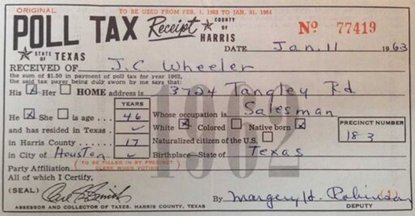
Figure 7.3 Houstonian James Wheeler received this hand-written receipt for paying his $1.50 poll tax in 1963. The poll tax was abolished by the Voting Rights Act of 1965. Carl Smith, whose office handled this transaction, remained Harris County Tax Assessor-Collector until 1998. Image Credit: Andrew Teas, License: CC BY
Since its admission to statehood in 1845, Texas has participated in every U.S. presidential election except the election of 1864 during the American Civil War, when the state had seceded to join the Confederacy, and the election of 1868, when the state was undergoing Reconstruction.
In its first century, Texas was a Democratic bastion, only voting for another party once – in 1928 when anti-Catholic sentiment against Al Smith drove voters to Republican Herbert Hoover. A gradual trend towards increasing social liberalism in the Democratic Party, however, has turned the state (apart from Hispanic South Texas, the Trans-Pecos, and several large cities) into a Republican stronghold. Since 1980 Texas has voted Republican in every election.
Historical Barriers to Voting in Texas
Texas shares with many other states – especially with former Confederate states – a history of the systematic disenfranchisement of blacks, Latinos, and poor whites. In the aftermath of the Civil War, many former Confederate states (and some others as well) instituted new restrictions on voting in order to disenfranchise former slaves. In response, Congress passed and the states ratified the 13th, 14th, and 15th Amendments to the U.S. Constitution which became known as the Civil War Amendments to counteract efforts by southern elites and their allies to reestablish political rule by disenfranchising black voters – thereby denying them representation in government.
The 13th Amendment (1865) abolished slavery. The 14th Amendment (1868) and 15th Amendment (1870) to the U.S. Constitution were passed to guarantee, respectively, the “privileges and immunities” and the right to vote of all U.S. citizens.
With the end of the Reconstruction in the 1870s, the nation politically abandoned uniform enforcement of the Civil War amendments. With reduced federal enforcement of the rights protected by the amendments, many southern states enacted Jim Crow laws designed to restrict or prevent African American voter participation. Unlike other states, Texas never legislated two of these tools: literacy tests and the grandfather clause. Instead, Texas suppressed black voting using poll taxes and the white primary.
Poll taxes added a direct out-of-pocket transaction cost to voting by charging money to vote. Texas adopted a poll tax in 1902. It required that otherwise eligible voters pay between $1.50 and $1.75 to register to vote – a lot of money at the time, and a big barrier to the working classes and poor. Poll taxes, which disproportionately affected African Americans and Mexican Americans, were finally abolished for national elections by the 24th Amendment to the U.S. Constitution, adopted in 1964. Two years later, the U.S. Supreme Court, in Harper v. Virginia Board of Elections, ruled that poll taxes in state elections were unconstitutional.
The white primary in Texas treated the Democratic Party as a private club whose membership could be restricted to citizens of Anglo heritage. It originated as a change in Democratic Party practice early in the twentieth century as a way to disenfranchise African Americans, and later in south Texas, Mexican Americans. In 1923 the white primary became state law. After numerous legal challenges to successive versions of the law the Legislature had passed to preserve the practice, the U.S. Supreme Court finally and decisively prohibited the white primary in the 1944 case Smith v. Allwright.
The ratification of the Twenty-Fourth Amendment in 1964 ended poll taxes, but the passage of the Voting Rights Act (VRA) in 1965 had a more profound effect. The act protected the rights of minority voters by prohibiting state laws that denied voting rights based on race. The VRA gave the attorney general of the United States authority to order federal examiners to areas with a history of discrimination. These examiners had the power to oversee and monitor voter registration and elections. States found to violate provisions of the VRA were required to get any changes in their election laws approved by the U.S. attorney general or by going through the court system. However, in Shelby County v. Holder (2013), the Supreme Court, in a 5–4 decision, threw out the standards and process of the VRA, effectively gutting the landmark legislation.
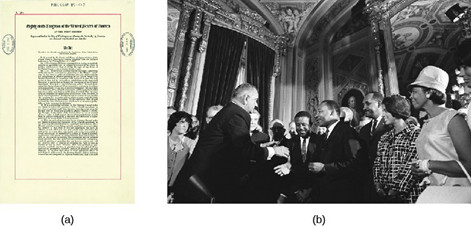
Figure 7.4 The Voting Rights Act (a) was signed into law by President Lyndon B. Johnson (b, left) on August 6, 1965, in the presence of major figures of the civil rights movement, including Rosa Parks and Martin Luther King Jr. (b, center). Image Credits: Public Domain; (b) Public Domain
Voter Decision Making
When citizens do vote, how do they make their decisions?
The election environment is complex and most voters don’t have time to research everything about the candidates and issues. Yet they will need to make a fully rational assessment of the choices for an elected office. To meet this goal, they tend to take shortcuts.
One popular shortcut is simply to vote using party affiliation. Many political scientists consider party-line voting to be rational behavior because citizens register for parties based upon either position preference or socialization. Similarly, candidates align with parties based upon their issue positions. A Democrat who votes for a Democrat is very likely selecting the candidate closest to his or her personal ideology. While party identification is a voting cue, it also makes for a logical decision.
Citizens also use party identification to make decisions via straight-ticket voting—choosing every Republican or Democratic Party member on the ballot. In some states, such as Texas or Michigan, selecting one box at the top of the ballot gives a single party all the votes on the ballot. Straight-ticket voting does cause problems in states that include non-partisan positions on the ballot. In Michigan, for example, the top of the ballot (presidential, gubernatorial, senatorial and representative seats) will be partisan, and a straight-ticket vote will give a vote to all the candidates in the selected party. But the middle or bottom of the ballot includes seats for local offices or judicial seats, which are non-partisan. These offices would receive no vote, because the straight-ticket votes go only to partisan seats.
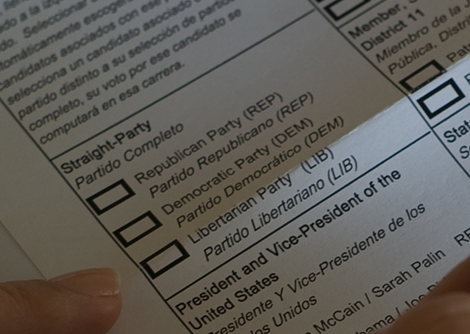
Figure 7.5 Straight-ticket option on Texas ballot in U.S. election in 2008. Image Credit: Lars Plougmann, License: CC BY SA
In 2010, actors from the former political drama The West Wing came together to create an advertisement for Mary McCormack’s sister Bridget, who was running for a non-partisan seat on the Michigan Supreme Court. The ad reminded straight-ticket voters to cast a ballot for the court seats as well; otherwise, they would miss an important election. McCormack won the seat.
Straight-ticket voting does have the advantage of reducing ballot fatigue. Ballot fatigue occurs when someone votes only for the top or important ballot positions, such as president or governor, and stops voting rather than continue to the bottom of a long ballot. In 2012, for example, 70% of registered voters in Colorado cast a ballot for the presidential seat, yet only 54% voted yes or no on retaining Nathan B. Coats for the state supreme court. Voters make decisions based upon candidates’ physical characteristics, such as attractiveness or facial features.
They may also vote based on gender or race because they assume the elected official will make policy decisions based on a demographic shared with the voters. Candidates are very aware of voters’ focus on these non-political traits. In 2008, a sizable portion of the electorate wanted to vote for either Hillary Clinton or Barack Obama because they offered new demographics—either the first woman or the first black president. Demographics hurt John McCain that year because many people believed that at 71 he was too old to be president.
Hillary Clinton was criticized in 2008 on the grounds that she had not aged gracefully and wore pantsuits. In essence, attractiveness can make a candidate appear more competent, which in turn can help him or her ultimately win.
Aside from party identification and demographics, voters will also look at issues or the economy when making a decision. For some single-issue voters, a candidate’s stance on abortion rights will be a major factor, while other voters may look at the candidates’ beliefs on the Second Amendment and gun control. Single-issue voting may not require much more effort by the voter than simply using party identification; however, many voters are likely to seek out a candidate’s position on a multitude of issues before making a decision. They will use the information they find in several ways.
Retrospective voting occurs when the voter looks at the candidate’s past actions and the past economic climate and makes a decision only using these factors. This behavior may occur during economic downturns or after political scandals, when voters hold politicians accountable and do not wish to give the representative a second chance.
Pocketbook voting occurs when the voter looks at his or her personal finances and circumstances to decide how to vote. Someone having a harder time finding employment or seeing investments suffer during a particular candidate or party’s control of government will vote for a different candidate or party than the incumbent.
Prospective voting occurs when the voter applies information about a candidate’s past behavior to decide how the candidate will act in the future. For example, will the candidate’s voting record or actions help the economy and better prepare him or her to be president during an economic downturn? The challenge of this voting method is that the voters must use a lot of information, which might be conflicting or unrelated, to make an educated guess about how the candidate will perform in the future. Voters do appear to rely on prospective and retrospective voting more often than on pocketbook voting.
In some cases, a voter may cast a ballot strategically. In these cases, a person may vote for a second- or third-choice candidate, either because his or her preferred candidate cannot win or in the hope of preventing another candidate from winning. This type of voting is likely to happen when there are multiple candidates for one position or multiple parties running for one seat.
In Florida and Oregon, for example, Green Party voters (who tend to be liberal) may choose to vote for a Democrat if the Democrat might otherwise lose to a Republican. Similarly, in Georgia, while a Libertarian may be the preferred candidate, the voter would rather have the Republican candidate win over the Democrat and will vote accordingly.
One other way voters make decisions is through incumbency. In essence, this is retrospective voting, but it requires little of the voter. In congressional and local elections, incumbents win reelection up to 90 percent of the time, a result called the incumbency advantage. What contributes to this advantage and often persuades competent challengers not to run? First, incumbents have name recognition and voting records. The media is more likely to interview them because they have advertised their name over several elections and have voted on legislation affecting the state or district. Incumbents also have won election before, which increases the odds that political action committees and interest groups will give them money; most interest groups will not give money to a candidate destined to lose.
Incumbents also have franking privileges, which allows them a limited amount of free mail to communicate with the voters in their district. While these mailings may not be sent in the days leading up to an election—sixty days for a senator and ninety days for a House member— congressional representatives are able to build a free relationship with voters through them. Moreover, incumbents have exiting campaign organizations, while challengers must build new organizations from the ground up. Lastly, incumbents have more money in their war chests than most challengers.
Voter Turnout and Political Participation in Texas
Introduction
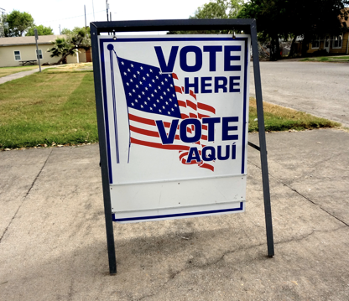
Figure 7.6 Sign posted in Taft, Texas during the United States presidential election in 2016. Image Credit: Jay Phagan License: CC- BY-2.0
This section discusses the factors influencing voter turnout and political participation in Texas.
Does Turnout Matter?
Houston doesn’t charge a fee for single-family home trash pickup. While most cities charge a monthly fee – usually added to the homeowner’s water bill – Houston simply used general fund tax revenue to pay for trash service provided only to single-family homes. Apartment residents help pay for this service, although they don’t receive it. They then pay again through their rent to have their own trash picked up by a private company. How can this be?
Before municipal elections in Houston, savvy candidates purchase walk lists from the Harris County Clerk’s office. A walk list is a list of street addresses at which at least one registered voter lives. When going door-to-door meeting voters and asking for support, a smart candidate will skip over houses where nobody is registered to vote. In time, candidates will realize that in a typical 100-house neighborhood, around 50 houses will probably contain at least one registered voter. How many registered voter households will that candidate find in a 100-unit apartment property?
Probably fewer than ten. Homeowners, with more roots in the community, are far more likely to register and vote than renters. Most candidates simply skip apartment properties – many of which are gated anyway – to concentrate on the more voter-rich single-family neighborhoods.
If a candidate gets elected, and is later sitting at a council meeting thinking about the wants and needs of his or her constituents, who do you think that council member is envisioning? Wouldn’t a policy to take money from a group of mostly non-voters to subsidize a service for a group that is highly likely to vote to make good political sense?
WATCH: Campaign 2014: Rock The Vote
Voter Turnout in Texas
After years of elections in which Democrats nominated largely unknown, underfunded candidates for many statewide offices, Republican Senator Ted Cruz was opposed in 2018 by El Paso Congressman Beto O’Rourke, an energetic campaigner and prolific fundraiser who raised over $70 million to Senator Cruz’ $33 million. Driven by the success of the “Beto” campaign and controversy generated by President Donald Trump, Democrats registered significant numbers of new voters, and saw an increased turnout of Democrat voters, especially in large cities. Overall, voter turnout among the voter-eligible population increased from 28.3% in the 2014 midterm election to 46.3% - the sixth-highest turnout increase in the United States, and higher than the turnout increase nationwide.
Still, Texas turnout was below the national average – 44th out of 51 states (plus the District of Columbia). What affects voter turnout, and why don’t more Texans vote?
Interested in mobilizing voters? Explore Rock the Vote and The Voter Participation Center for more information.
Factors Affecting Voter Turnout
Political scientists pay tremendous attention to voter turnout – examining all the factors that predict who will and won’t show up to vote in an election. Voter Eligibility
First, it is important to remember that not everybody is legally able to vote. Citizens of other countries – whether in the United States legally or illegally cannot vote in American elections. Children under the age of 18 cannot vote. Texans younger than 18 make up more than a fourth of the state’s population.
Removing those who can’t vote from the total population leaves what political scientists call the voting-eligible population (VEP). The VEP includes citizens eighteen and older who, whether they have registered or not, are eligible to vote because they are citizens, mentally competent, and not imprisoned. Voter Beliefs and Attitudes
There are as many reasons not to vote as there are non-voters, but some factors seem to stand out. Many don’t vote because they don’t see any benefit – lacking political efficacy, or the feeling that they have any influence over the direction of their government.
Some don’t vote because they see little difference between the parties or the candidates. Many voters are unlikely to vote in elections they see as not being competitive – a common situation in Texas where general elections were dominated by the Democratic Party for more than a century after the Civil War, and by the Republican Party since the 1990s.
Many political scientists look at political socialization - the process by which we initially acquire our political ideals and behaviors, and which have a strong influence on our voting behavior throughout our lives. Demographic and Socioeconomic Factors
Besides homeownership, many other factors are associated with difference in turnout. Older people are more likely to vote than younger people. Native Texans are more likely to vote then immigrants. Lower English proficiency is strongly correlated with low voter turnout. Texas, a state that skews young and Hispanic, has those factors working against high voter participation. Voter ID Requirements in Texas
Low turnout also occurs when some citizens are not allowed to vote. One method of limiting voter access is the requirement to show identification at polling places.
In 2011, Texas passed a strict photo identification law for voters, allowing concealed-handgun permits as identification but not student identification. The Texas law was blocked by the Obama administration before it could be implemented because Texas was on the Voting Rights Act’s preclearance list. Other states, such as Alabama, Alaska, Arizona, Georgia, and Virginia similarly had laws and districting changes blocked.
Proponents of voter ID requirements in Texas see increasing requirements for identification as a way to prevent in-person voter impersonation and increase public confidence in the election process. Opponents say there is little fraud of this kind, and the burden on voters, especially specific voter demographics, restricts the right to vote and imposes unnecessary costs and administrative burdens on elections administrators. A chart reflecting the growth in Voter ID requirements
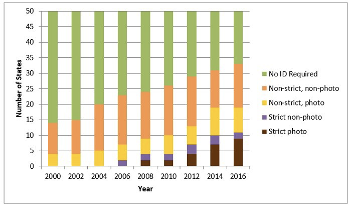
Figure 7.7 Image Credit: National Conference of State Legislators - Voter ID History (http://www.ncsl.org/research/elections-and-campaigns/voter-id-history.aspx)
A map of voter ID requirements in the U.S.
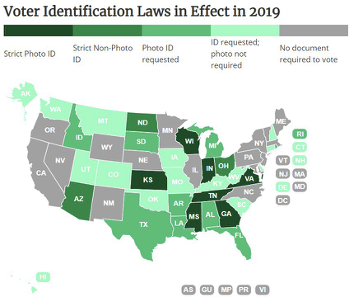
Figure 7.8 A total of 35 states have laws requesting or requiring voters to show some form of identification at the polls, all of which are in force in 2018. In Texas, a photo ID is required to vote. Voters who do not possess an acceptable form of photo ID, and cannot obtain one, can present a supporting form of ID and execute a Reasonable Impediment Declaration. Visit the National Conference of State Legislators (NCSL) website and scroll over the interactive map below for state-by state comparison of voter ID requirements. (http://www.ncsl.org/research/elections-and-campaigns/voter-id.aspx)
Increasing Turnout
In 2015, Oregon made news when it took the concept of Motor Voter further. When citizens turn eighteen, the state now automatically registers most of them using driver’s license and state identification information. When a citizen moves, the voter rolls are updated when the license is updated. While this policy has been controversial, with some arguing that private information may become public or that Oregon is moving toward mandatory voting, automatic registration is consistent with the state’s efforts to increase registration and turnout.
Oregon’s example offers a possible solution to a recurring problem for states—maintaining accurate voter registration rolls. During the 2000 election, in which George W. Bush won Florida’s electoral votes by a slim majority, attention turned to the state’s election procedures and voter registration rolls.
Journalists found that many states, including Florida, had large numbers of phantom voters on their rolls, voters had moved or died but remained on the states’ voter registration rolls.
The Help America Vote Act of 2002 (HAVA) was passed in order to reform voting across the states and reduce these problems. As part of the Act, states were required to update voting equipment, make voting more accessible to the disabled, and maintain computerized voter rolls that could be updated regularly.
Over a decade later, there has been some progress. In Louisiana, voters are placed on ineligible lists if a voting registrar is notified that they have moved or become ineligible to vote. If the voter remains on this list for two general elections, his or her registration is cancelled. In Oklahoma, the registrar receives a list of deceased residents from the Department of Health.
Twenty-nine states now participate in the Interstate Voter Registration Crosscheck Program, which allows states to check for duplicate registrations. What are some ways that Texas could increase voter turnout? Some feel Texas could make voting more convenient. Some states allow instant registration in person or online, no-excuses absentee balloting and mail-in balloting. Texas does have absentee voting (where an individual does not need to be physically present at the poll to cast their ballot), and early voting (17 days before and 4 days until the regular election).
At the national level, some attempts have been made to streamline voter registration. The National Voter Registration Act (1993), often referred to as Motor Voter, was enacted to expedite the registration process and make it as simple as possible for voters. The act required states to allow citizens to register to vote when they sign up for driver’s licenses and Social Security benefits. On each government form, the citizen need only mark an additional box to also register to vote. Unfortunately, while increasing registrations by 7 percent between 1992 and 2012, Motor Voter did not dramatically increase voter turnout. In fact, for two years following the passage of the act, voter turnout decreased slightly. It appears that the main users of the expedited system were those already intending to vote. One study, however, found that preregistration may have a different effect on youth than on the overall voter pool; in Florida, it increased turnout of young voters by 13 percent.
Most major elections in Texas are held on Tuesday. Employers in Texas are required to provide two paid hours off from work for employees to vote, but some suggest that making election day a national holiday or simply holding more elections on weekends could increase turnout. Better outreach to citizens with limited English proficiency has seen promising results in some states. Australia has compulsory voting – like jury duty. The failure to vote can result in a ticket and a small fine. Some have even suggested paying people to vote – a recognition of the value of voting and the time voters must invest. Studies show that voters simply make better citizens. Voting is associated with stronger social ties, better health outcomes, lower recidivism – even better mental health. Also, the government simply makes better decisions when more citizens participate.
Political Participation
Introduction
While political scientists tend to focus on voting, there are other ways citizens participate in the policymaking process.
Campaigning
Citizens who want to do more than vote can involve themselves in political campaigns in a variety of ways from donating money to volunteering. Political campaigns are labor-intensive, and any candidate will tell you that volunteers are critical to a successful run for office. Campaign volunteers go door-to-door, distribute literature, post yard signs, make phone calls and help fold, stuff and stamp mailings.
Running for Office
While wealthy people with established careers have an advantage in elective politics, as in most things, ordinary people win elections throughout Texas every year, serving in positions from school board to the state legislature and beyond. In 1990, 18-year-old high school senior John Payton was elected Justice of the Peace in Collin County, Texas. His mother drove him to neighborhoods after school so he could campaign door-to-door. Payton defeated incumbent Jim Murrell in the Republican Primary before graduating from Plano East Senior High, then went on to win the November general election. Though dismissed initially as a “fluke,” Payton went on to serve nearly 30 years before stepping down in 2019.
Political Activism
On May 3, 1980, 13-year-old Cari Lightner was killed by a drunk driver, who had been released from jail two days before following his fourth DUI arrest. Cari’s mother, Candace Lightner and other parents of drunk driving accident victims formed Mothers Against Drunk Drivers, an interest group that has had a profound influence on the passage and enforcement of tougher laws against drunk driving. In Texas, political activists of every imaginable type have worked – alone or in groups – to influence public policy with varying degrees of success.
Legal
Some individuals and interest groups find the legal system to be an effective means of political participation. In 1973, there was almost no chance of elected officials overturning laws prohibiting abortion. Instead of seeking a political solution, activists sought relief through the courts. In Roe v. Wade, abortion advocates were able to overturn a Texas law prohibiting abortion, obtaining a court ruling that a woman’s right to an abortion is protected by an implied right of privacy in the Due Process clause of the Fourteenth Amendment.
Supporters of environmental causes have found the court system to be similarly useful, stopping politically popular public works projects with lawsuits alleging violation of federal law, such as the Endangered Species Act.
Glossary: Voting and Political Participation in Texas
ballot fatigue: occurs when someone votes only for the top or important ballot positions, such as president or governor, and stops voting rather than continue to the bottom of a long ballot
Jim Crow Laws: This term, which came to be used to designate any law requiring racial segregation, was borrowed from a racially stereotyped black character in a common nineteenth-century song-and-dance act.
compulsory voting: an effect of laws which require eligible citizens to register and vote in elections, and may impose penalties on those who fail to do so.
grandfather clause: Part of the system of Jim Crow in southern states used to enforce segregation in primary elections. In its typical usage, a voter could vote in Democratic primary elections if his grandfather had been able to vote in Democratic primaries. Blacks whose ancestors had been slaves were thereby excluded but whites were made eligible, even poor whites who might otherwise be disenfranchised by the burden of a poll tax or by literacy requirements.
literacy test: A test of a voter’s ability to read and understand and hence vote intelligently, typically used in a discriminatory manner in some states until Congress suspended the use of such tests in the Voting Rights Acts of 1970 and 1975.
political efficacy: the feeling that they have any influence over the direction of their government
poll taxes: A tax of a fixed amount per person levied as a condition of voting. Poll taxes generally were not intended to raise revenue so much as to restrict the size of the electorate by making voting more costly. Amendment Twenty- Four added to the U.S. Constitution in 1964 outlawed the use of a poll tax as a pre-condition for voting in any election for federal office. The U.S. Supreme Court extended the ban to all state and local elections in 1966.
walk list: a list of street addresses at which at least one registered voter lives
white primary: primary election in which only white voters are eligible to participate
Licenses and Attributions
CC LICENSED CONTENT, ORIGINAL
Voting and Political Participation in Texas: Glossary. Authored by: Andrew Teas. License: CC BY: Attribution